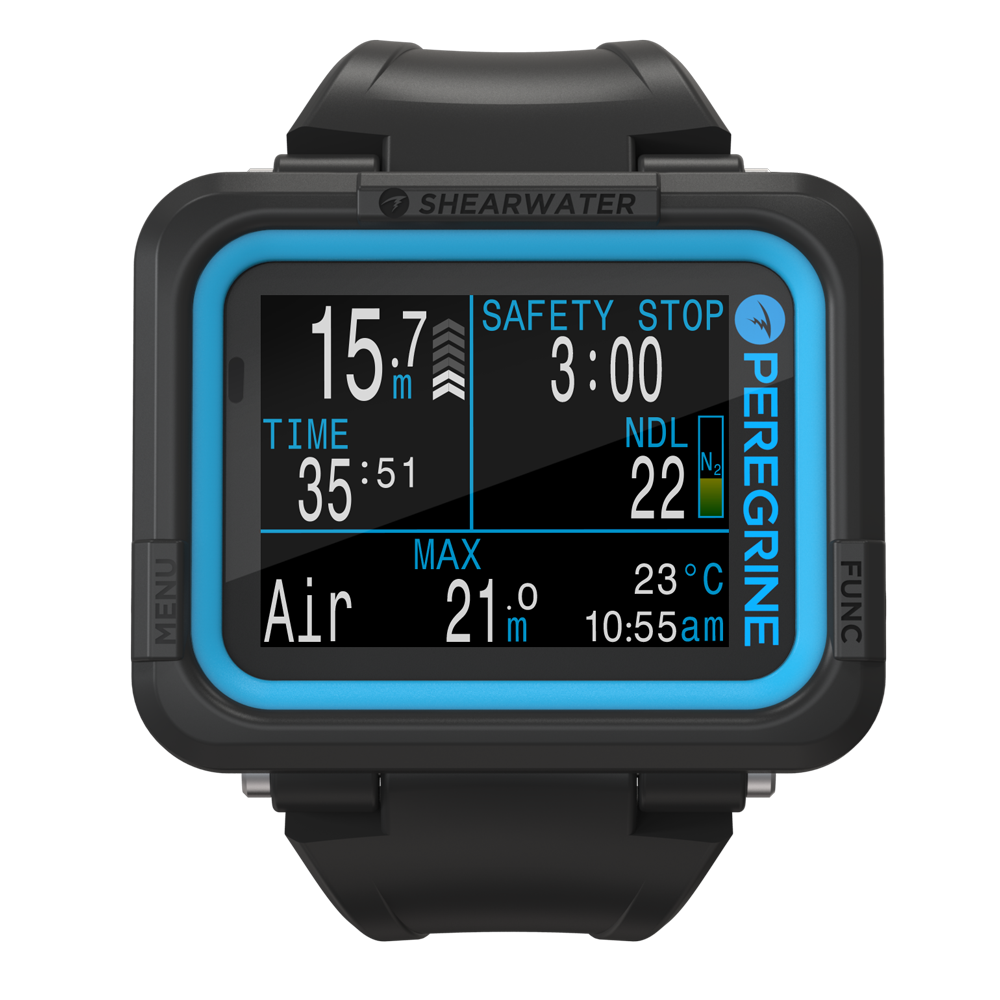
For most recreational divers, the Shearwater Peregrine ($570) is the best dive computer in 2026 — full Bühlmann ZH-L16C, colour OLED, user-replaceable battery, and a reputation for not breaking. On a tight budget the Cressi Leonardo ($190) does the job. Skip: the Suunto Zoop Novo (algorithm cuts bottom time too aggressively) and the Oceanic VTX (overpriced for what you get).
The 8 computers worth comparing
Wrist-mount dive computers only — console computers and watch-form-factor units sit in separate articles. What you’ll see on dive boats from Koh Tao to Komodo in 2026 are these eight.
How they compare visually
Price
The Cressi Leonardo at $190 is the cheapest legitimate dive computer in this comparison. Below that price you’re in counterfeit / no-warranty territory. The Oceanic VTX at $700 is the only entry where the price feels disconnected from the engineering — it’s priced like a Tern but performs like a Puck Pro+.
Maximum depth rating
For recreational diving (40m max), anything above 60m is theoretical. The depth rating is mainly a proxy for how seriously the housing was engineered. The Zoop Novo at 80m is the only entry where the rating feels tight — it’s adequate, not generous.
Battery life on a typical 50-minute dive
Battery serviceability matters more than people think. The Peregrine takes a single AA — buy a four-pack at any 7-Eleven if it dies. The Garmin G1 is rechargeable and needs a USB charger on liveaboards (most boats have power, but bring a cable). The Oceanic VTX has a sealed battery that drains faster than its competitors and isn’t user-replaceable.
Detailed per-computer verdicts
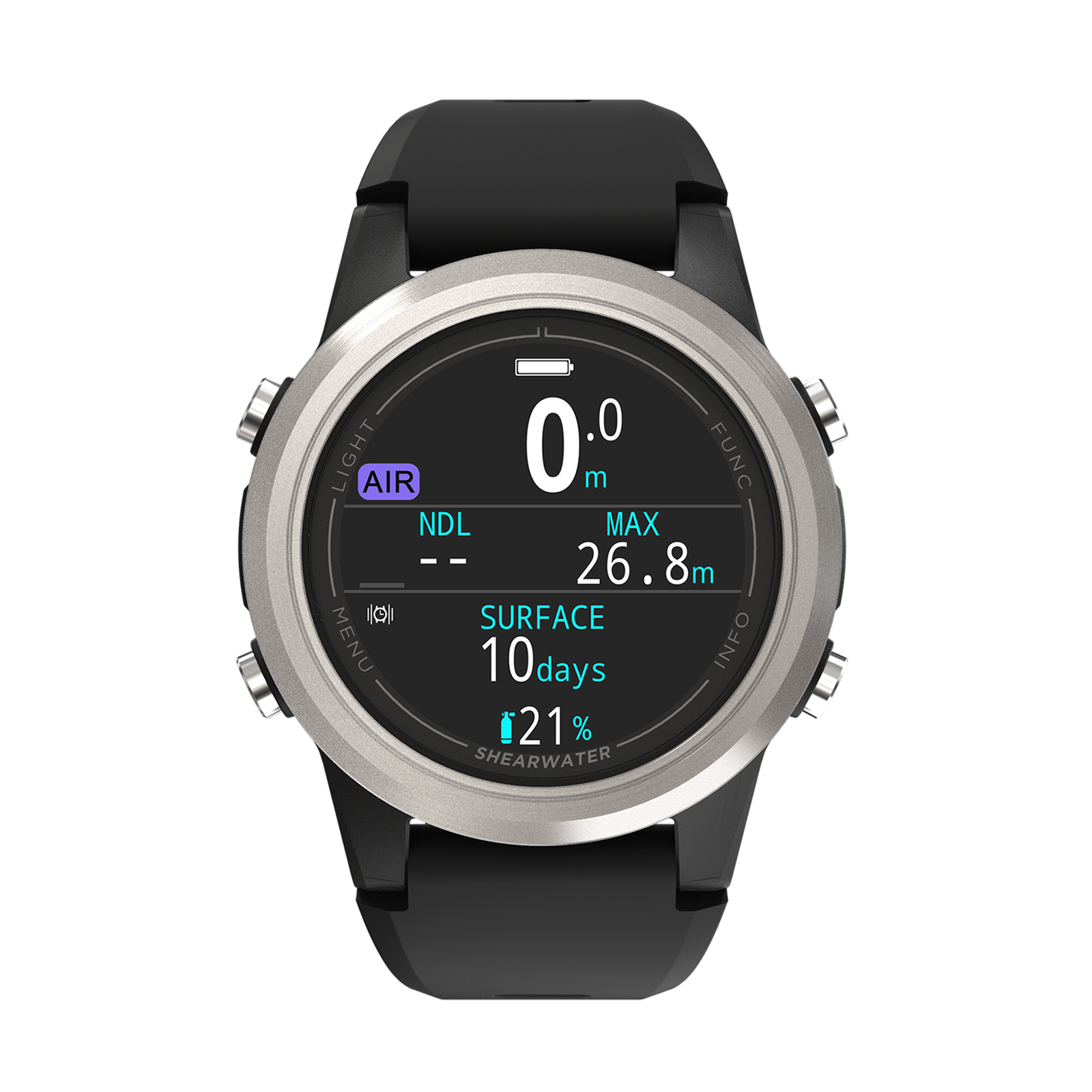
Shearwater Peregrine
Best overall 2026
$570 · 20,000 THB
100m depth · colour OLED · user-replaceable battery · Bühlmann ZH-L16C / GF · no AI
Shearwater Peregrine — best overall in 2026
The Peregrine launched in 2020 and Shearwater has been refining it through software updates ever since. By 2026 it’s the default recommendation from every dive instructor who isn’t getting kickbacks.
What’s good:
- Full Bühlmann ZH-L16C with adjustable gradient factors — same algorithm Shearwater puts in their $1,500 tech computers
- Colour OLED display readable in any condition (bright sun, low-vis green water, night)
- User-replaceable AA battery. One AA = roughly 50–80 dives. Replace it yourself in 30 seconds.
- Free software updates for life via Bluetooth and the Shearwater Cloud app
- The Shearwater reputation: warranty service is fast, breakages are rare, support actually responds
What’s missing:
- No air integration on the Peregrine (you need the Tern or the Perdix 2 AI for that)
- No watch mode — purely a dive computer
- Slightly chunkier on the wrist than the Mares Puck Pro+
Best for: any recreational diver buying their first or second computer. The algorithm honesty alone (more bottom time than Suunto, similar to Garmin) pays back the $570 over a couple of trips.
Skip if: you specifically need air integration without paying tech-diver money (look at the Mares Puck 4 instead) or you want a watch you’ll wear daily (Garmin G1).
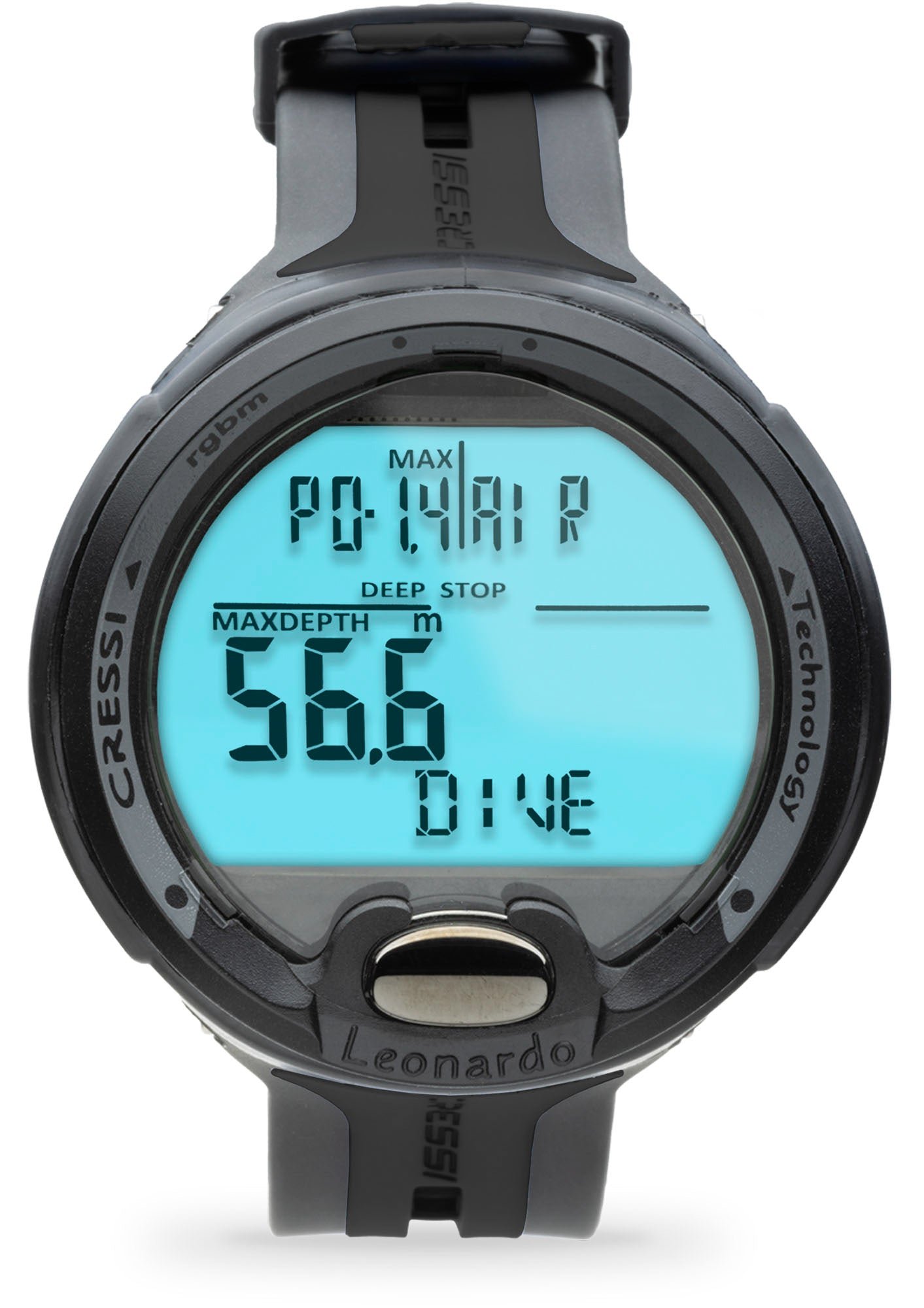
Cressi Leonardo
Budget winner
$190 · 6,700 THB
120m depth · monochrome LCD · user-replaceable battery · Cressi RGBM · single-button navigation
Cressi Leonardo — the budget winner
Italian-made, single-button operation, basic but honest. The Leonardo has been on the market since 2011 with incremental updates and is the dive computer most divemasters in Asia loan to students.
What’s good:
- $190 — the cheapest legitimate computer in this comparison
- Cressi’s RGBM is a Haldane-derived algorithm that doesn’t penalise repetitive diving as heavily as Suunto’s
- Single CR2430 battery, user-replaceable, costs $3 at any electronics shop
- 120m depth rating is generous for the price
- Backlit LCD readable in low-vis
What’s missing:
- Single button — menu navigation is tedious. You’ll need to read the manual twice.
- No PC/Bluetooth log download on this model (you can buy the Cressi Leonardo+ for the upgrade at +$70)
- Conservative on deep repetitive dives — bottom time penalty is real
- LCD only, no colour
Best for: entry-level divers, dive students, anyone diving 5–10 times a year who doesn’t want to spend $500+ on something they’ll use occasionally.
Skip if: you log every dive obsessively (no Bluetooth download), or you’re doing 3+ deep repetitive dives per day (algorithm penalty stacks).
image pending
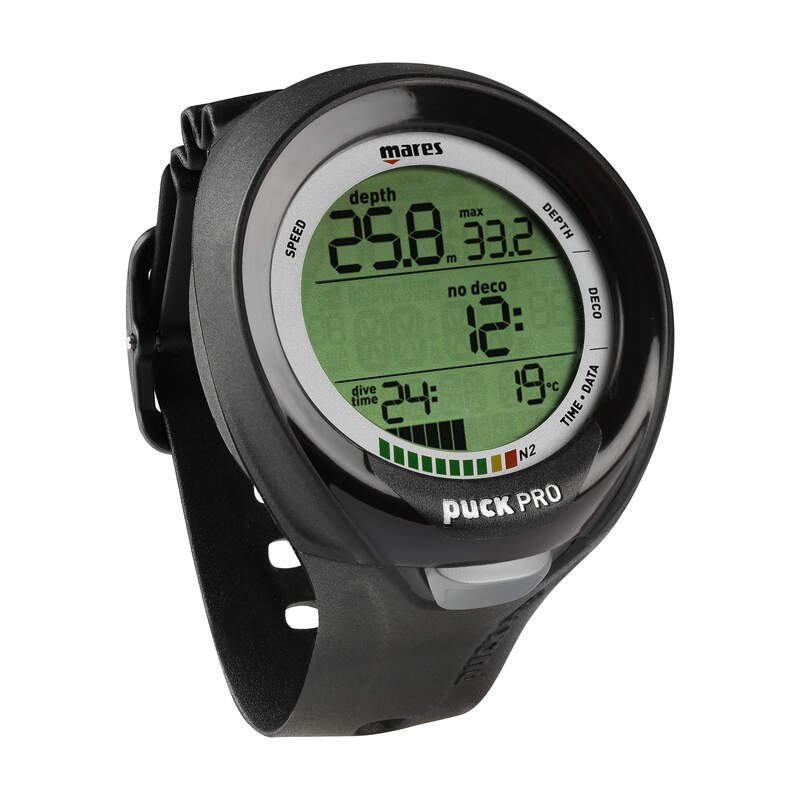
Mares Puck Pro+
Indestructible value pick
$250 · 8,800 THB
100m depth · monochrome LCD · user-replaceable CR2450 · Mares RGBM · Bluelink Bluetooth
Mares Puck Pro+ — the indestructible value pick
Same form factor as the original Puck Pro from 2012 but with a redesigned button layout and updated Mares RGBM. Sells for $250 and the build quality matches computers twice the price.
What’s good:
- Single-button operation (Mares actually solved single-button navigation — it works)
- Bombproof housing — drop tests, scratch resistance, real dive boat survival
- CR2450 battery, user-replaceable, lasts ~200 dives. Best battery economy in this comparison.
- Mares RGBM gives reasonable bottom time (more than Suunto, less than Bühlmann)
- Excellent backlight for night diving
What’s missing:
- LCD is bare-minimum, no colour
- Algorithm is conservative compared to Bühlmann options at the same price (Peregrine adds $320 for that)
- USB log download requires a Mares cable ($40 separate)
Best for: divers who want a backup computer, dive professionals who want something reliable they don’t have to baby, anyone diving in conditions where they expect the computer to take a beating.
Skip if: you want maximum bottom time at depth (the algorithm holds you back) or you want one good computer rather than a backup.
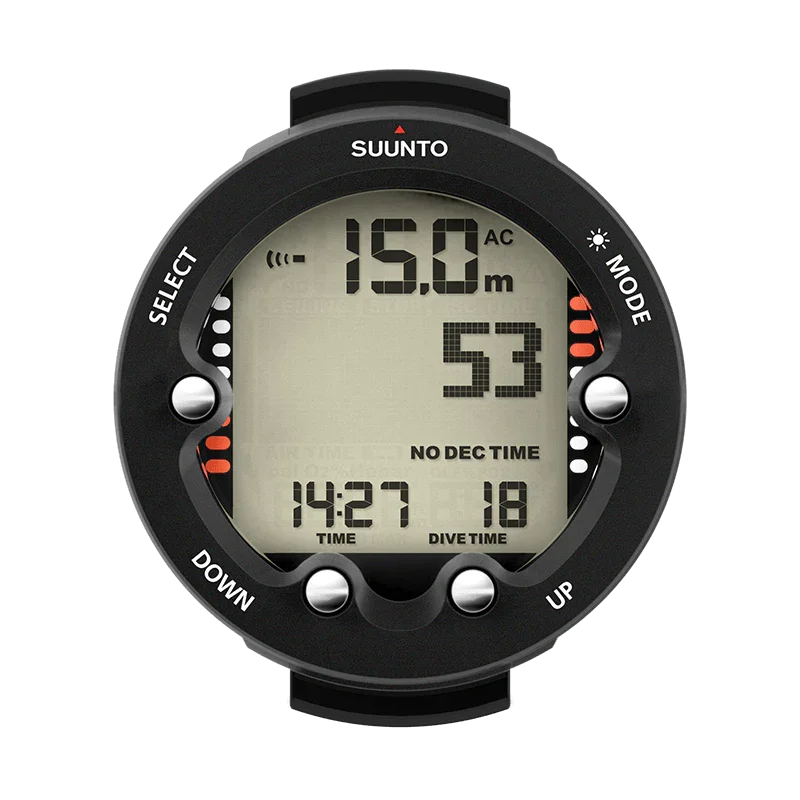
Suunto Zoop Novo
Capable but ageing
$240 · 8,400 THB
80m depth · monochrome LCD · user-replaceable · Suunto RGBM (conservative) · 4 dive modes
Suunto Zoop Novo — capable but ageing
The Zoop Novo replaced the original Zoop in 2014 and has been on dive boats globally ever since. Solid, reliable, and increasingly outclassed at its $240 price.
What’s good:
- Trusted Suunto Fused RGBM algorithm — well-understood by dive instructors and DAN
- 4-button navigation (easier menus than single-button competitors)
- CR2450 user-replaceable, ~120 dives per battery
- The dive log on the Zoop is excellent — clean storage, good Suunto app integration once you download
What’s missing:
- 80m depth rating — lowest in the comparison
- Suunto RGBM is the most conservative algorithm here. Divers regularly report 5–10 minutes less bottom time per dive vs Peregrine or G1 at the same depth and gas. Over a week of liveaboard diving that adds up.
- LCD only, basic
- Suunto Bluetooth dongle for log download is $45 separate
Best for: divers who trained on Suunto and want familiar menus, or those diving in cold or low-vis conditions where extra conservatism is welcome.
Skip if: you frequently dive close to no-stop limits and care about every minute of bottom time. The Suunto algorithm gives less than Bühlmann (Peregrine, Garmin G1) on identical dives.
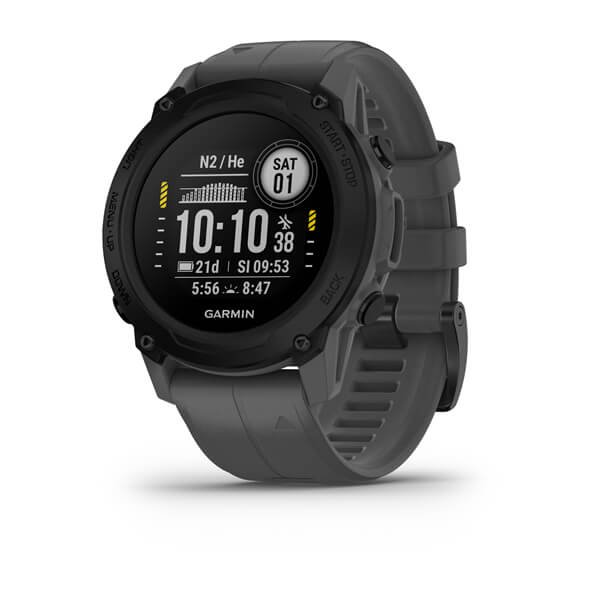
Garmin Descent G1
Best value watch-style
$499 · 17,500 THB
100m depth · mono MIP display · 35h dive battery · Bühlmann ZH-L16C · full Garmin smartwatch features
Garmin Descent G1 — see the watch comparison
Covered in detail in the dive watch comparison. Short version: best value if you also want a fitness watch / daily-wear device. Bühlmann algorithm, 100m depth, 35h dive battery, $499. Skip if you want a dedicated dive-only computer (Peregrine is better at $570).
image pending
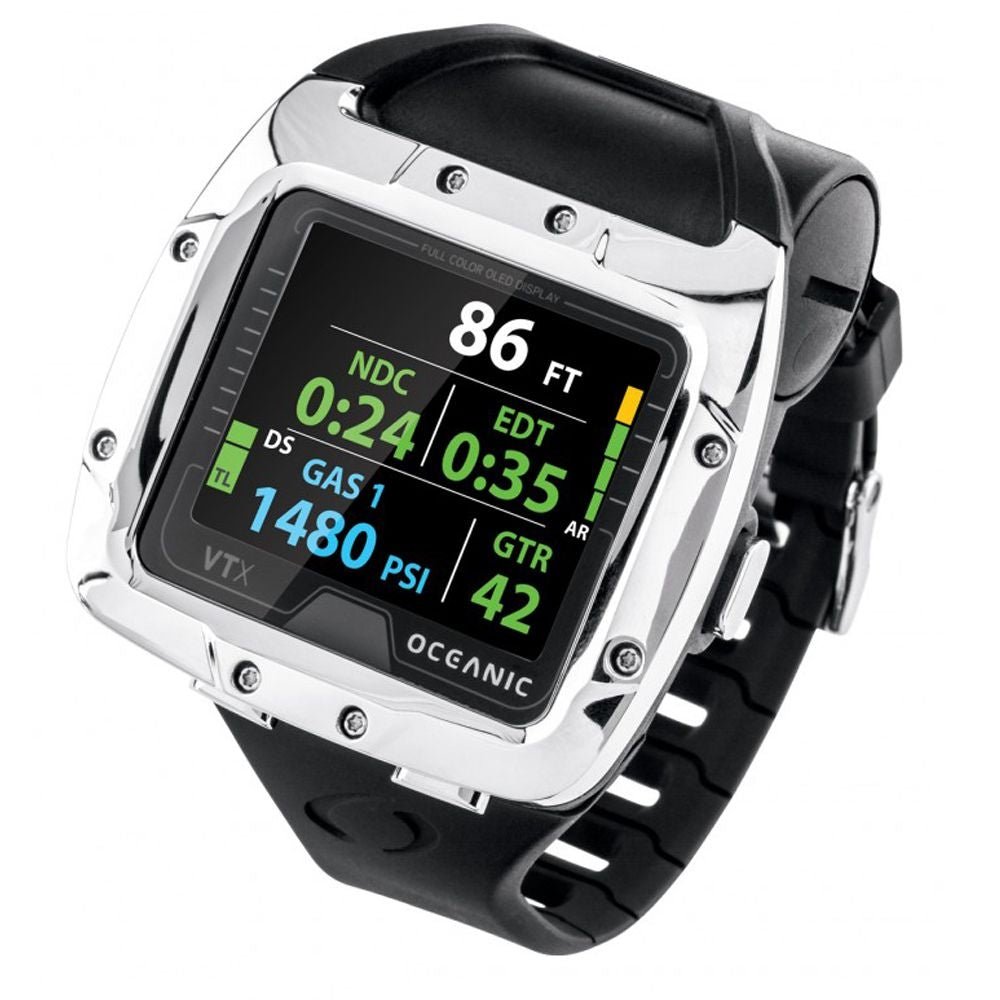
Oceanic VTX
Overpriced
$700 · 24,500 THB
100m depth · colour LCD · user-replaceable · Pelagic Z+ / DSAT · optional transmitter AI
Oceanic VTX — overpriced
The Oceanic VTX has been around since 2014. Aqualung-owned Oceanic markets it as a premium recreational computer with optional air integration. The reality at $700 in 2026:
What’s good:
- Colour LCD (not OLED) is bright and readable
- Pelagic Z+ algorithm is competitive with Bühlmann (Pelagic also licenses to Aeris and Hollis)
- Air integration available with the AI 2 transmitter ($300 separate)
- Single-button + side button — easier than pure single-button
What’s missing:
- $700 is Tern territory for clearly older hardware
- Battery is user-replaceable but the housing seal is finicky — many divers have flooded these resealing them, leading to expensive warranty claims
- Software updates have basically stopped — Oceanic-Aqualung’s dev focus is elsewhere
- The colour LCD draws more battery than competitors — ~50 dives per battery vs Mares Puck Pro+‘s 200
Best for: existing Oceanic-Aqualung loyalists with the AI 2 transmitter ecosystem.
Skip if: you’re not already locked into the ecosystem. The Peregrine is better and cheaper. The Tern is better and slightly more expensive.
Shearwater Tern
Recreational with tech-diving headroom
$735 · 25,700 THB
200m depth · colour OLED · integrated rechargeable · Bühlmann ZH-L16C + Trimix · Swift transmitter AI
Shearwater Tern — recreational with tech-diving headroom
The Tern launched in 2024 as Shearwater’s recreational entry with air integration. It uses the same chassis ideas as the Peregrine with a rechargeable battery, AI capability, and Trimix unlock for divers who later go technical.
What’s good:
- Bühlmann ZH-L16C + gradient factors, same as Shearwater’s tech computers
- 200m depth rating
- Air integration via the Shearwater Swift transmitter ($375 separate)
- Trimix capable — unlocks when you’re ready for tech diving (one purchase, future-proofed)
- Colour OLED, 30h dive battery, USB-C rechargeable
- All the Shearwater reliability and support reputation
What’s missing:
- Rechargeable battery means no AA backup if it dies mid-trip (carry a cable)
- $735 + transmitter ($375) = $1,110 total for AI setup
- Overkill for divers who’ll never do tech
Best for: divers who plan to progress to tech diving (Trimix, deep deco) and don’t want to buy twice. Also the right pick if you want air integration on a Shearwater without paying Perdix prices.
Skip if: you’ll never dive past 40m and don’t need air integration. Get the Peregrine and save $165.
image pending
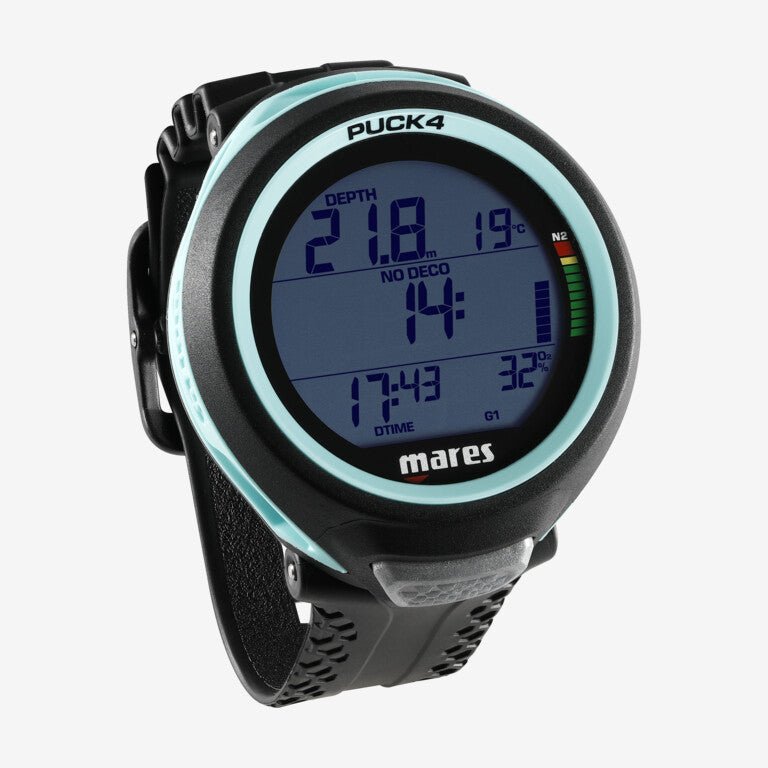
Mares Puck 4
Sleeper pick for air integration
$310 · 10,800 THB
150m depth · monochrome LCD · user-replaceable battery · Mares RGBM · T2 transmitter compatible
Mares Puck 4 — sleeper pick for air integration
Updated 2023, the Puck 4 is Mares’ attempt to compete in the $300–400 air-integrated segment. T2 transmitter compatible, 150m depth, button-only.
What’s good:
- $310 makes it the cheapest air-integrated computer that’s actually worth owning
- 150m depth, generous for the price
- T2 transmitter from Mares is $300 vs Shearwater’s $375 — saves $75
- Mares RGBM with adjustable conservatism settings
- Bombproof Mares build quality
What’s missing:
- Single-button menus inherited from earlier Pucks — slow to navigate
- LCD only, no colour
- Algorithm is conservative vs Bühlmann
- Mares software is the weakest of the major brands — log management is clunky
Best for: budget-conscious divers who specifically want air integration. Total cost (Puck 4 + T2 = $610) undercuts the Peregrine + needing-a-second-computer-for-AI logic.
Skip if: you don’t need air integration (Peregrine at $570 is a better single-purpose computer).
Buying decision framework
Use this in order:
- Have you bought a dive computer before? No → Shearwater Peregrine. Yes → keep reading.
- Budget under $300? → Cressi Leonardo ($190) or Mares Puck Pro+ ($250).
- Do you want air integration? Yes → Mares Puck 4 + T2 (cheapest path) or Shearwater Tern (best path).
- Will you progress to tech diving? Yes → Shearwater Tern (Trimix unlockable later).
- Want a single device for watch + diving + daily wear? → Garmin Descent G1.
Battery type: replaceable vs rechargeable
This decision is bigger than people realise.
User-replaceable (Peregrine, Pucks, Zoop, Cressi, Oceanic): swap in 30 seconds. Battery is $3–8 at any electronics shop. If your computer dies on day 5 of a liveaboard, you’re not stuck. Downside: you need to reseal the battery compartment correctly, or you flood the housing.
Rechargeable integrated (Garmin G1, Shearwater Tern): charge via USB-C/proprietary cable. No battery economy concerns. Downside: when the battery degrades after 5–7 years, the unit goes back to the manufacturer for ~$120 replacement service. And on a liveaboard, no power = no diving.
For Thailand-based recreational divers doing 10–30 dives a year: user-replaceable is the safer choice. For divers travelling with full kit who always have a charging cable available: rechargeable is fine.
Algorithm honesty: why your computer matters
A “conservative” algorithm doesn’t mean safer — it means less bottom time at depth. DAN’s incident database does not show fewer DCS cases on Suunto RGBM than on Bühlmann ZH-L16C at default settings. What you get with conservative algorithms is fewer minutes per dive.
For a 25m dive on air:
- Bühlmann ZH-L16C (Shearwater, Garmin): ~30 min no-stop
- Mares RGBM (Pucks): ~26 min no-stop
- Pelagic Z+ (Oceanic): ~28 min no-stop
- Suunto Fused RGBM (Zoop Novo, default): ~22 min no-stop
Over a week of 3 dives per day at 25–30m, the Suunto vs Bühlmann gap is roughly 30–40 minutes of lost bottom time. That’s a paid dive.
This isn’t about safety — properly executed, all four algorithms are safe within their no-stop limits. It’s about value. If you’re paying for dive trips, the algorithm matters.
What to skip and why
Anything below $150 on AliExpress/Lazada/Shopee. No algorithm validation, no warranty, no software updates, often counterfeit branding. The Cressi Leonardo at $190 is the legitimate floor.
Suunto D4i Novo. Discontinued. Still on shelves at some shops at discount prices. Don’t buy — no software updates, replaced by the Suunto D5.
Oceanic Geo 4.0. Sub-$300 Oceanic computer. Adequate but outclassed by the Mares Puck Pro+ at the same price with better battery life and tougher housing.
Aqualung i330R. Re-badged Pelagic platform. Same issues as the Oceanic VTX at a similar price.
Mares Smart Air. Console-style, not a wrist computer. Solid product but not in this comparison.
Real-world reliability ranking
Based on dive shop service logs, DAN incident reports, and forum data across r/scuba, ScubaBoard, and the European dive community over 2023–2026:
- Shearwater (Peregrine, Tern) — fewest failures, fastest warranty service, best support response
- Mares (Puck Pro+, Puck 4) — bombproof hardware, slower software/firmware iteration
- Cressi (Leonardo) — surprisingly reliable; failures usually housing seal after DIY battery change
- Garmin (Descent G1) — solid; occasional firmware bugs fixed via update
- Suunto (Zoop Novo) — established reliability, slow on bug fixes, ageing platform
- Oceanic (VTX) — most flooding reports in this list, mostly housing seal-related after battery service
Where to actually buy in Thailand
- Lazada Thailand / Shopee — Mares, Cressi, Suunto at fair price; check for authorised seller badge before buying for warranty validity
- Dive shops on Koh Tao and Phuket — limited stock, dive-shop prices (10–15% above online), often offer in-store setup
- Shearwater — order online via Shearwater.com or authorised dealer (Davy Jones Diving Phuket carries Peregrine); ~3–4 weeks to Thailand with international warranty
- Garmin Thailand — local warranty, full retail price
- Oceanic / Aqualung — Aqualung Thailand distributor in Bangkok; service network is solid here
Grey-market saves 10–15% but means international warranty service if anything fails. For a $200 Leonardo that’s fine; for a $735 Tern it’s not.
Verdict
If we had to pick one for a friend without knowing their situation: Shearwater Peregrine. Best recreational dive computer at any price. User-replaceable battery, honest algorithm, support that actually responds.
For divers on a budget: Cressi Leonardo. It’s been on the market 15 years for a reason.
For divers who want air integration without paying tech-diver prices: Mares Puck 4 + T2 transmitter. Total $610.
For tech-curious recreational divers: Shearwater Tern. Trimix-unlockable, future-proofed.
Skip the Oceanic VTX unless you’re locked into the Aqualung ecosystem. Skip the Suunto Zoop Novo if bottom time matters to you.